THE SHIPYARD
Latest Update: 19
August 2013
Over the last few years, I’ve generated quite a few SSDs for
various reasons. Many of these were
projects I came up with in my free time … something just comes to mind and I
draw up an SSD. Others were done for
friends, suggested by other players, or created to provide captured ships for
use in local campaigns. I’ve done my
best to provide reasonable BPVs and other data, but players should still use a little
caution when including them in their own gaming. The MSC for all non-tournament ships on this
page is located here.
ALTERNATE TOURNAMENT SHIPS
Federation Tournament Light Command Cruiser (TCLC): This is the
revised version of an alternative tournament ship I developed for the
Federation. It is based on the NCL.
NOT SANCTIONED.

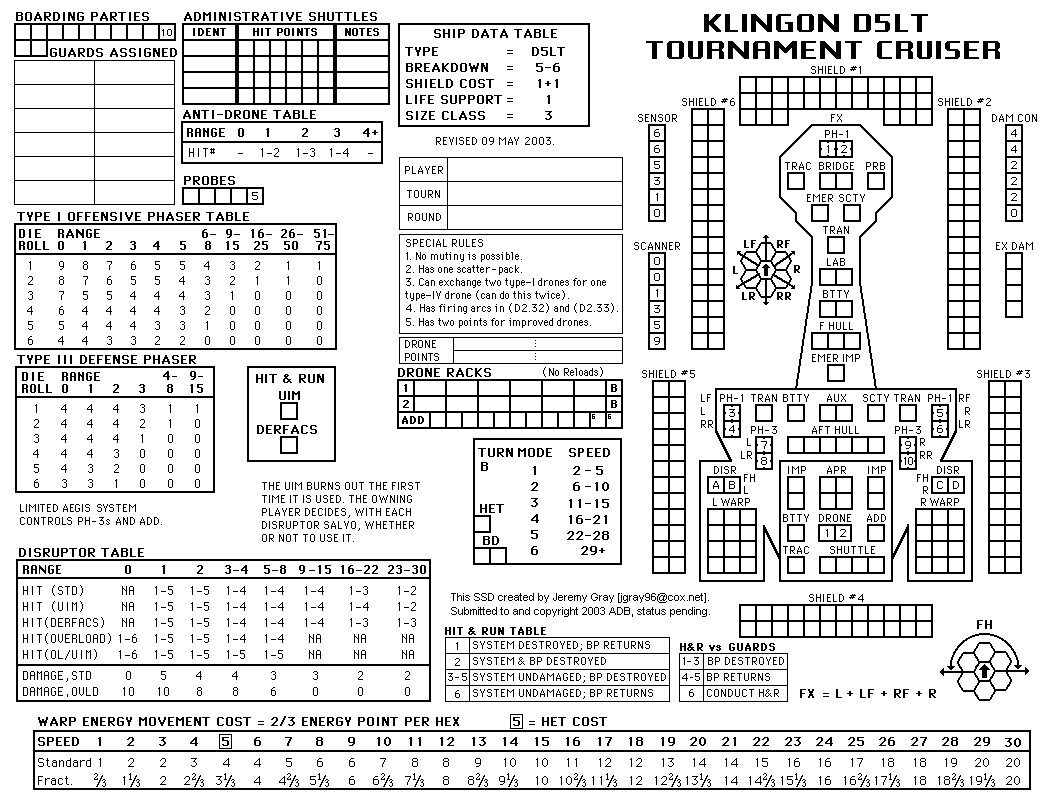
KLINGON D5LT TOURNAMENT WAR CRUISER (D5LT): This is an alternate Klingon Tournament
Cruiser I did some time ago for a friend.
It is great saber dancer, but it has even less internal fortitude than
the D7CT. Updated 09 Mar 03 based on playtesting. NOT SANCTIONED.
ROMULAN TOURNAMENT KING FALCON (TKF): The TKF is probably one the more off-the-wall
ideas I’ve ever come up with. I wanted
to explore the possibility of a mauler in a tournament ship. The ship is based on a greatly expanded
version of the King Falcon that appeared in SFT #34. The changes are too numerous to list, but the
focus was to bring the ship in line with the capabilities of most tournament
ships. The ship is subject to shock,
with a shock rating of 21. It also has
the same non-transportable T-bomb used on the TKE. While the last thing the tournament needs is
another Romulan ship, this one is sufficiently
different to make it an interesting side note in unofficial tournament ship
games. NOT SANCTIONED.

Gorn
Tournament Medium Cruiser (TCM): This ship, based on the Gorn
Medium Cruiser, is intended as an alternative to the existing Gorn TCC. It features twin FP Plasma-S launchers,
more warp (but not more power), and more Phaser-3s (but not a larger phaser capacitor). NOT SANCTIONED.

HYDRAN TOURNAMENT MOHAWK CRUISER (TMHK): An alternate Hydran
ship that features an all fusion-fighter armament has been brought up on
occasion by tournament players. This
ship is my best attempt at such a ship.
The all fusion-fighter armament is very vulnerable outside of range two,
but if this ship can ever get to point blank range, no opponent will survive
the encounter. NOT SANCTIONED.

ANDROMEDAN INTERLOPER TORUNAMENT CRUISER (TIN):
The Andromedan has proved to be the most difficult
ship, by far, to balance for tournament play.
I designed this ship as an alternate proposal to ADB. Ultimately, ADB chose to stick to a variation
on the already-existing design. The Interloper
attempts to mimic the layout of an Intruder-class ship, though greatly
reduced to keep it competitive with other TCs.
NOT SANCTIONED.

FRAX TOURNAMENT SUB (STC): This ship is based on the Frax
SCW. It retains all of the Frax submarine capabilities, including a fully functional
AFD and the ability to fire drones and axion
torpedoes while cloaked. It may not
exchange Type-I drones for Type-IVs, but all drones are equipped with ATG, and
three of the Type-I drones in each drone rack are equipped as Catfish Drones
(FD51.0). Also note that the rules for
Missile Racks specify that these are loaded with Type-IV drones (FD52.0). The STC has two points for improved drones,
but has no dogfight drones in its AFD.

Any ship facing the SCW in a tournament duel
receives two t-bombs (no dummies) that may dropped via
a shuttle bay or laid by transporter.
This is to offset its unique ability to fight while cloaked and to
launch cloaked drones. This T-bomb
addition should not be used in any other type of battle (non-duels) involving
tournament ships. NOT SANCTIONED.
CARNIVON TOURNAMENT HEAVY CRUISER (TCA): I designed this ship to bring the Carnivons, an Early Years race, into the tournament. The ship uses a number of special rules,
outlined on the SSD. Playtesting
so far suggests that this ship is very well balanced against existing
tournament ships. NOT SANCTIONED.

FEDERATION SHIPS
Heavy
Plasma Dreadnought (DNP): The DNP is an unbuilt
variant of the Federation DNH. It is based on the plasma armed DNF (introduced
in Module R7) with the DNH improvements installed. The single existing DNF might have been
converted to this configuration later in the General War, but it is unlikely
that the Federation would have been willing to pull a powerful unit like the
DNF out of the battle line that late in the war for an upgrade.

Names: Entente
(never converted).
HEAVY
PHOTON DREADNOUGHT (DNJ): Borrowing from concepts presented in the
Federation DNF, DNH, and BCJ, the DNJ represents the ultimate expression of
photon armed warships (short of conjectural BBs). Subject to shock like the BCJ, it is assumed
that such a ship would not have appeared until sometime in the Y180's.

Names: Star Empire (never completed).
Breaker
Dreadnought (DNB): The Breaker was
proposed as a class of ships expressly designed for assaulting Starbases. The concept
was discussed at length on the SFB Discussion Board. Big and slow, but with enough firepower to
directly assault a starbase, such a ship would only
be considered in extreme wartime cases.

Unbuilt
variant.
Name: Trinity (never completed).
Improved
Heavy Carrier (CVW): A fourth Federation CVA,
may have been built in this improved configuration in Y179 (records are unclear
– the exact number of Federation CVAs remains something of a mystery). The design featured significantly improved
firepower (approaching the same standard as the DNG) and a redesigned shuttle
bay to make more efficient use of heavy fighters on semi-external links (these
function under the same rules as the Fed SCS (R2.32). It appears that the
Federation had plans to upgrade the surviving CVAs to this configuration, but
the high demand for these ships at the front made pulling them out of combat
for a lengthy conversion impossible. The
development of the SCS design a few years later ended any possibility of
further CVW production – all future construction or conversions would be
completed to that standard.

The CVW uses the
same shuttle bay and balcony configuration at the SCS (described in (R2.32)),
except the side bays hold only six fighters each. Like the SCS, this ship did not operate the
F-111, and could have only carried four of them (the larger fighters blocked
two of the six semi-external links).
From the outset, the one CVW operated a fighter group composed entirely
of megafighters (these are shown on the SSD). It was designed to operate with an E3A Heavy
SWAC and an E2A SWAC, along with two MRS shuttles (shown on the SSD but not
included in the BPV). A drogue of some
type was also normally carried – this was usually a seeking weapon drogue (also
shown on the SSD – not included in the BPV).
The CVW has the same drone storage capacity as the CVA.
The CVW operated interchangeably with the other
CVAs, and used the same escorts listed in (R2.13).
Names: Genghis
Khan.
Designer's note: This is an SSD I developed
during a conversation on the ADB BBS that discussed the possibility of an
improved Federation CVA.

Battlecruiser
(BC): The Alaska class was the original design for the
Federation BC. The Alaska was the
first true heavy battlecruiser launched by any race,
entering service in the Fall of Y176. It
made use of the same saucer design originally developed for the Federation CV
in Y169. Production was halted after the
lead ship was completed in favor of the BCG and BCF models that became the
preferred standard.

Names: Alaska,
Hawaii (cancelled), Guam (cancelled).
Designer's
update: A very similar ship, with a slightly different phaser
arrangement has now been published in Captain's Log.
Fleet
Carrier (CV): While records are unclear, it appears the Federation completed a
single ship of this class in Y169. The
predecessor to very successfully CVA (R2.13), this ship was the first built by
any race in the Alpha Quadrant to field such a large fighter group. This design was actually the origin of the
saucer used in the Federation Battlecruisers
introduced in Y176 (see the BC description above). The prototype of this very
large cruiser hull proved to be extremely costly and Federation engineers
looked for an alternative based on an existing hull form, which led to the
introduction the CVA. Further ships of
the CV class were cancelled.

The CV uses the
same shuttle bay and balcony configuration at the CVA (described in
(R2.13)). It originally operated with a
mixed fighter group of F-4s, F-8s, and A-6s, shown in a separate SSD. The ship later received the same fighter
group as the standard CVA. Finally, in
Y177, the CV had its 12 A-10s replaced with 6 A-20 Heavy Fighters. It would operate in that configuration for
the rest of its career. It was designed
to operate with two E2 SWACs, but often had to make due with one, as it
received lower priority than the CVAs.
If only one SWAC was available the ship carried an MRS, but if two E2
SWACs were carried, the MRS was omitted.
After Y178, the ship usually operated a single E3 Heavy SWAC and a MRS. The CV has 400 spaces of drone storage for its fighters –
less than the stockpile carried on the larger CVA.

The CV operated interchangeably with the
slightly larger CVAs, often shifting to various theaters of operation to serve
on defensive patrols. This filled gaps
left by the newer CVAs and allowed them to freely engage in more aggressive
offensive operations.
|
Year |
Escorts |
Fighters |
|
Y169-71 |
CE, DE, FFE |
|
|
Y171-75 |
CE, DE, FFE |
12xF-14, 12xA-10 |
|
Y175-77 |
CEA, DEA, FFA |
12xF-14, 12xA-10 |
|
Y177-79 |
CEA, DWA, FFA |
12xF-14A, 6xA-20 |
|
Y179-84 |
NAC, DWA, FFA |
12xF-14A, 6xA-20F |
|
Y184-89 |
NAC, 2xDWA |
12xF-14B, 6xA-20F |
|
Y190-95 |
NAC, 2xDWA |
12xF-14C, 6xA-20F |
|
Y195+ |
NAC, 2xDWA |
12xF-14D, 6xA-20F |
These are the
historical escort and fighter assignments for the CV. When the ship switches from
A-10s to A-20s, the spare shuttle line in the MSC
changes from 2+4 to 2+2+1.
Names: Alexander
the Great.
Designer's note: This is an SSD I developed for
use with the old Commanders Edition Fed CVA miniature before the release of
SSJ1, which had a revised SSD for a two-engined
CVA. My version is not as powerful, but
it does suggest why the Federation would have opted to drop this type of ship
in favor of a DN-based CVA.
Fast
Battlecruiser (FBC): In Y185, the Federation planned to complete a
variation of the Bismarck Class BCF as a Fast Battlecruiser. It was hoped that this ship would prove to
be as successful as the venerable DNL.
However, the success of the CX class made such a ship unnecessary and
work stopped on the incomplete ship.
Little more than a secondary hull, the ship was placed in “mothball”
storage – providing a ready replacement in the event one of the serving BCs
lost it rear hull in an emergency separation.
Had the CX program failed, this ship, and possibly more like it, might
have been completed

The incomplete FBC hull would eventually be used
to complete the first Federation BCX (coming soon).
Unbuilt
variant.
Name: Jutland (never completed).
Advanced Battlecruiser (BCX): While the Federation was on the cutting edge with the introduction of the first Advanced Cruiser in Y181, the CX eventually found itself outclassed by less numerous, but more powerful X-ships produced by several neighboring empires. Under pressure from the Adromedan Invasion, the Federation commissioned a handful of more powerful BX-class Advanced Battlecruisers. Unlike the first BCs which preceded the BX by over a decade, the new ships featured a modular design that allowed weapons in the dorsal mounts to be added and removed in a few hours time at a X-base. Structural limitations prevented the fitting of photons without subjecting the ship to shock similar to the BCJ, but the shock rating was much higher (21). As a result, photons were rarely fitted as shock threatened to shorten the operational lives of these very expensive warships.

Designers Note: The whole modular weapon thing is just to avoid making a bunch of different SSDs, and the above text is a cover. The ships doesn't add a lot of power over the standard CX (only 2), but it does increase firepower, depending on what weapons go in the dorsal mount. Considering 6-gun X-cruisers like the Klingon DX/Lyran CCX+BCX or "bigger" X-cruisers like the NH-X, I don't think this ship is too out of line (the plasma armed version would be pretty freakin' scary). Even so, BCXs have largely been a no-go as far as ADB is concerned...so this is not likely to become historical.
Names: Proxima, Federation (replacing
the original DN bearing the name in Y190)
Improved
Heavy Cruiser (CG): A number of Federation CAR+ class ships were
converted to this improved standard after Y175.
The CG upgraded mirrored many of the improvements of the CB class,
including full power and shield upgrades.
No new construction CGs were completed (the NCA
being preferred); all CGs were conversions of existing ships.

Names: Constitution, Yorktown, Hood (rebuilt), Excelsior, El
Dorado, Krieger, Antietam, Pharsalus, Hastings, Arbela.
Improved
Strike Carrier (CBV):

Armored
Heavy Cruiser (CP): A middle-years variant of the standard Heavy
Cruiser, the cruiser featured armor distributed around the hull to provide a
greater degree of protection.
Unfortunately the added mass increase the ship's movement cost, and the
ship was considered a failure.

Name: Monitor (prototype only).
Fast
Scout Carrier (CVFS): During the Andromedan
War, the CF Eagle was converted to Fast Scout Carrier, similar in
appearance to the CVF Gryphon (R2.96) lost in
Y177. While outwardly similar, the Eagle
received a number of unusual features to make it a potent raider for use
against the Andromedan Rapid Transit Network.
The photons were omitted to make way for a pair of scout sensors. The large
shuttle bay has been replaced with mech links for
A-20s and a small flight of F-18s is embarked for local defense. Two
drone racks were added to match those present in the saucer of the
CVS/CVB. If not acting as an independent
raider, the CVFS would use the same escorts as the CVF.

The CVFS might
have been built as early as Y178 to replace the lost Gryphon. However, Star Fleet did not see an urgent
need for the ship and the design was left on the drawing board until the Andromedan Invasion.
Name: Eagle.
Heavy
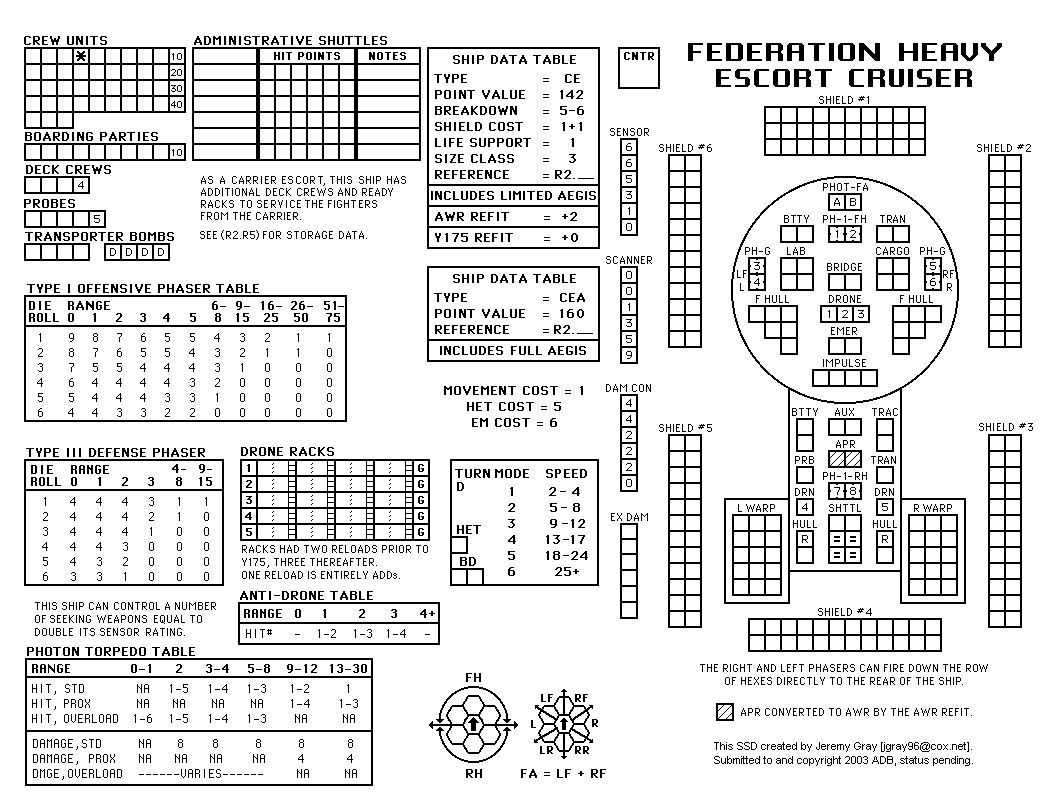
Escort Cruiser (CE): In Y169, the Federation completed the conversion
of the CAR+ Hornet to this heavy escort configuration for service with
the new CV Alexander the Great (see above). The design shared many
features with the smaller DE (R2.14), including the retention of two of the
ship’s original photons. The larger hull allowed the addition of a fifth drone
rack and an expanded shuttle bay that allowed for four fighter ready
racks. An AWR refit was completed
shortly after the ship completed its conversion, bringing it up to the same
power standard as other CAs in the fleet.
The CE proved to be an outstanding escort, however, Star Fleet was unwilling to sacrifice
further CA production to build additional ships of the type, which had proved to
be very expensive. The converted light
cruisers of the ECL class, introduced in Y171, were deemed to be satisfactory
as a cruiser-based escort and could be produced at a much lower cost. Any possibility that further CEs would be
produced after the start of the General War ended with the introduction of the
NEC and subsequent NAC. These new escort
classes provided almost identical features as the older CE and could be
produced much faster (and for much lower cost).
In Y175, the CE limited Aegis system was
improved to the more capable full Aegis system.
The ship continued to serve with the equally unique CV until Y179, when
the CEA was lost in combat with the Klingons.
It was replaced by an NAC in the CVs escort group.
The CE can control a number of seeking weapons
equal to double its sensor rating. As a
carrier escort, the ship has four deck crews and four ready racks to support
the fighters of its carrier group, but carries no fighters of its own. Like other Federation escorts, the CE carries
extensive stores for the carrier group’s fighters in its cargo box (R2.R5).
Names: Hornet.
Advanced
Carrier (CVX): While other races
began to phase out many carriers following the General War in favor of PFs, the
Federation continued to garner an interest in fighter technology. Various carrier designs appeared, including
this one, introduced during the Andromedan War. Developed as a dedicated RTN hunter, the CVX
featured a combined fighter group of F-14s and A-20Fs.

Names: Nimitz,
Nelson, Yamamoto.
2X
Advanced Cruiser (CXX): Experimental
Second Generation X-Cruiser. Special
rules not evident on the SSD:

S-bridge - limited scout functions if powered like a special
sensor.
Shield Regenerator – powered for 1 point of power per turn in EA,
repairs up to 6 damaged shield boxes at the player’s choice during EOT of the
same turn.
Unless otherwise noted, ship uses the same rules as a first
generation X-ship.
STRIKE
CRUISER (CS): This is my original proposal for the Federation CS,
which was published in Module R9. The
design has changed a bit (for the better I think) from this original
design. The basic precept remains the
same: The CS was a competitor for the
NCL that was no selected for series production.
Only a prototype was completed.
See module R9 for the now official ship design.
The Strike Cruiser design
was based on heavy modification of the proven Heavy Cruiser class. By deleting
laboratory space from the ship's saucer, systems from the original aft hull
could be moved forward and a rear hull of lower mass could be fitted. A major
feature of this redesigned hull was the lowered engine supports, which moved
the engines clear of the side phasers and allowing a
wider field of fire. The lower total mass lowered the ship's movement cost,
which increasing the ship's discretionary power.
The publication of the CS prompted an F&E
discussion on an interesting what if:
What is the Federation elected to build the CS instead of the NCL? This started an interesting debate on the SFB Discussion Board. As a side bar, I developed variant designs
for a few ships that might have been if the CS entered series production
instead of the NCL:
STRIKE DRONE CRUISER (CSD)
STRIKE ESCORT (CSE)
STRIKE ESCORT (Romulan Border)
(CSR)
STRIKE SCOUT (CSC)


Note, there is no leader, no LTT equivalent, no strike
carrier. The role of leader would fall
the old CC+ (and later CB), and the CVS/CVB would remain in production as the
backbone of the carrier force. Tugs
would need to soldier on without the help of LTTs, but that is a sacrifice the
Feds would have to make to take advantage of the CS.
New
Galactic Survey Cruiser (NGSC): This design for a survey cruiser based on the
NCA hull was not selected for production by Star Fleet, the NSR (R2.110) design
being preferred. While the NGSC retained
the four special sensors of the earlier GSC, it fell short of the NSR in a
number of categories. Most importantly,
the designed differed so much from the standard NCA that any ships of this type
would have required new construction (the changes were too extensive for economical conversion of existing hulls).

The SSD shows two
wartime configurations of the NGSC. It
would have carried the same fighter group as the GSV while operating as a
carrier and the same Marine contingent as the COV while operating as a commando
ship. Delete the ready racks shown on
the SSD when the ship is not operating as a carrier (their cost is included in
the refit to the NGSV configuration – it is not part of the base BPV). If operated in the NGSV configuration, it
would have used the same escorts listed in (R2.110A).
Unbuilt Variant.
Designer's Notes:
This is a ship I designed prior to the release of Module R10. It has been posted because it is
significantly different from the ship that was actually published in that
module. This should not be confused with
the official ship.
New
Heavy Drone Cruiser (NCAD): This alternative design to the NDC, optimized
for independent drone bombardment missions, entered service in Y180. Only one ship of this class was ever built,
serving almost exclusively on the Klingon front.

Names: Manzikert.
Designer's Notes:
This is a ship I designed prior to the release of Module R10. It has been posted because it is
significantly different from the ship that was actually published in that
module. This should not be confused with
the official ship.
New
Heavy Plasma Cruiser (NCAF): This alternative design to the NCF, optimized
for squadron fire support missions.

Names: Derfflinger
Designer's Notes:
This is a ship I designed prior to the release of Module R10. It has been posted because it is
significantly different from the ship that was actually published in that
module. This should not be confused with
the official ship.
Medium Cruiser Squadron: The CM is a
totally conjectural warship based on the Miranda or Avenger type
ships in several Trek publications. The squadron SSD shows a typical squadron
of these ships. The CM is designed to
include the megaphaser is from module P6 on a
modified the M-phaser wing that also to supports the
photon deck.

The CM is capable
of saucer separation. If it does so, the
photon deck, wing batteries, and megaphasers are
removed along with the warp engines. The
CMD would lose its special sensors.
These ships are
conjectural.
New
Light Megaphaser Cruiser (NCL-M): This is a standard NCL with the twin Megaphaser wing from module P6 added.

This ship is
conjectural.
(Old)
Light Guided Weapons Cruiser (CLG):

(Old)
Light Plasma Cruiser (CLL):

(Old)
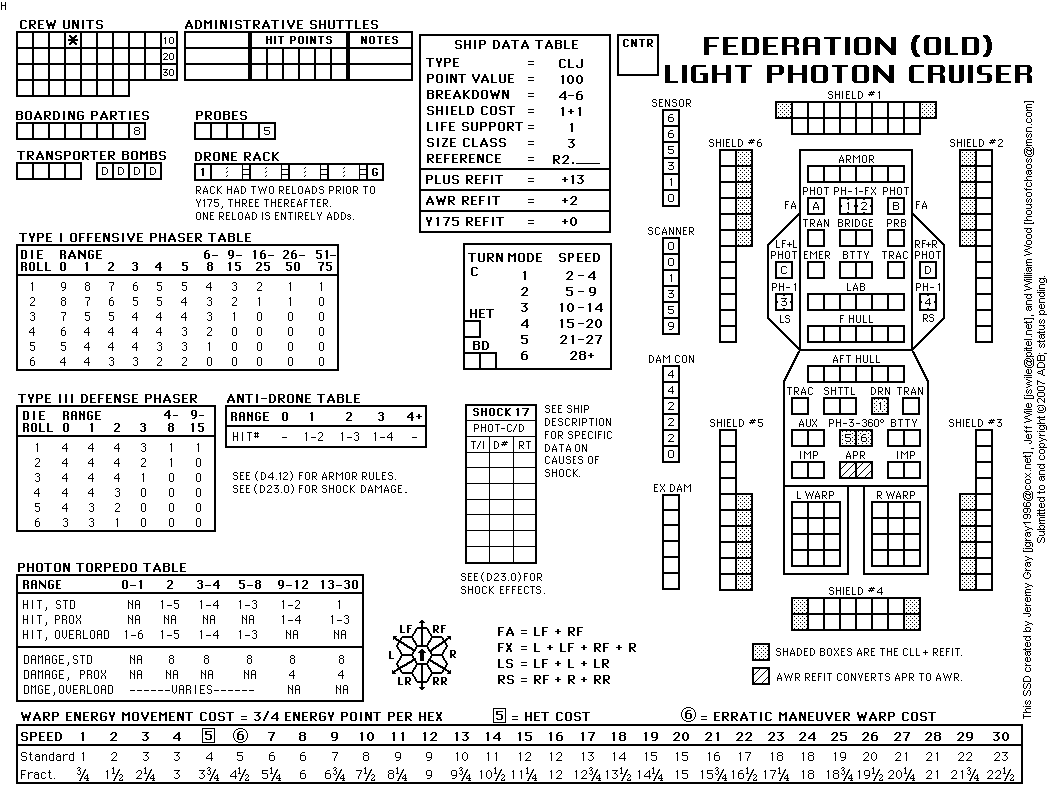
Light Photon Cruiser (CLJ):


Galactic
Survey Destroyer (GSD):

Heavy
Destroyer (HDD): In
Y168, as Star Fleet began to consider alternative designs to fill the role of
the aging CL (R2.5). Two independent
design teams submitted proposals for prototypes to fill the requirements
established by Star Fleet. The two designs were the NCL (which was ultimately
accepted) and the HDD.

The HDD was a modification of the
existing DD (R2.6) to support the addition of two small warp engines used by
the FF (R2.25). The ship retained the
majority of the destroyer’s systems, including the large lab facilities. The new design also featured improved shields
and a single drone rack. The added mass
raised the ships movement cost significantly, but the greater warp power would
allow much more effective use of the ship’s four photons. The HDD emphasized the use of existing
components and production facilities, sited by the designers as an advantage
over the NCL, which required a new warp engine type.
However, the HDD ultimately proved
inferior to the NCL for a number of reasons.
The additional warp engines did not improve the DD’s maneuverability or
breakdown rating. The NCL featured
better shielding, more copious shuttle facilities, greater potential for future
alteration, simplified internal structure and better maneuvering
attributes. Finally, the complex
alteration of the DD’s structure to support the additional engines on the
prototype proved more costly than the designers had anticipated, precluding the
conversion of existing DDs to the HDD configuration. This financial failure ultimately doomed the
HDD. No additional ships were produced
or converted, and the NCL entered production in Y170.
The single HDD remained in service
with Star Fleet. In Y174, half of the
labs were converted to AWRs, but the additional ph-3s and shielding of the NCL
were not added due to space restrictions.
The ship was lost in combat later in the war.
Names: Oldendorf.
New
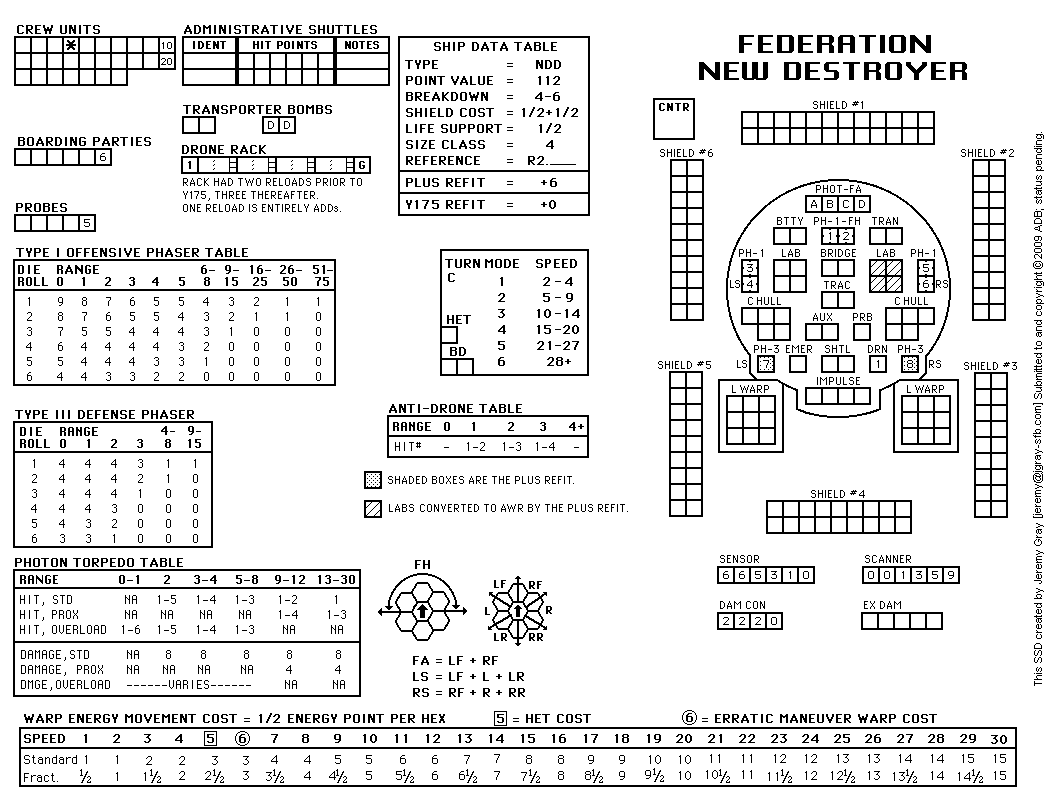
Destroyer (NDD): (Alternate Version)


Advanced
Heavy Destroyer (HDDX): Like the CSX,
intended to fill the gap between the DDX and CX. Additionally, the HDDX design incorporated
modular sections to allow quick conversion to variant designs as the
operational and strategic environment changed in the post-General War period.

Names:
Designer's Notes:
This is a ship I designed prior to the release of Module X1R. It has been posted because it is
significantly different from the ship that was actually published in that
module. This should not be confused with
the official ship.
Large
Frigate (CG): (Previous Version)


Frigate
Leader (FFC): Three frigate hulls were completed in this configuration in Y165
to act as frigate squadron leaders. It
was hoped that these ships could be used to mimic the practice in other fleets
of operating squadrons of frigates for routine patrols. The FFC was seen as a way to provide enhanced
firepower to such a squadron. However,
the ships proved much more expensive to produce than anticipated and the
overloaded hulls (not sufficient to produce shock) quickly became maintenance
nightmares. Star Fleet opted to use DDG
and DDL class ships as frigate squadron leaders, and further FFC production was
cancelled.

The three ships
did not survive long in their original configuration. The Richthofen
was converted to an FFV in Y168. The
remaining two ships were converted to FFEs in Y170.
Names: Richthofen, Oliver Hazard Perry, Issac Hull.

Fast War Destroyer Scout (DFS):


Fast
Romulan Border Escort Frigate (FRF):


Captured D5 War Cruiser: This is a captured D5 hull converted for service in Star Fleet
using the “Brothers of Anarchist” article in Captain’s Log 23. This ship could operate effectively with
NCLs, though it would have a lower top speed while arming photons.
Captured
Kzinti Light Cruiser (ZCL):

Captured E4
Escort: This captured E4 hull was
designed prior to the publication of the “Brothers of Anarchist” article in
Captain’s Log 23 article, which would have produced a slightly different
arrangement. Specifically, the drone rack would have been changed to a
shuttle and the boom impulse engine would have been retained.
Federation Fighters and Bombers:

KLINGON SHIPS
C7W
Super-Heavy Cruiser (C7W):

C11
Super-Heavy Cruiser (C11):


FD7D
Fast Drone Battlecruiser (FD7D):

FD7Y
Fast Drone Bombardment Cruiser (FD7Y):

FD7V
Fast Strike Carrier (FD7V):

D-10X
2X Advanced Cruiser (D10X): Experimental Second Generation X-Cruiser. Special rules not evident on the SSD:

Shield Shunt – powered for 1 point of power per turn in EA, allows
up to 10 points of damaged shielding to be swapped with undamaged shield boxes
from other shields.
Unless otherwise noted, ship uses the same rules as a first
generation X-ship.
D-5WA NEW HEAVY STASIS CRUISER (D5WA):
If the Klingons had chosen to convert new-construction D5Ws to carry a stasis
field generator, rather than convert D5As to D5Was, the ship might have
appeared in this configuration. Its only
significant difference is the use of disruptors (like the D7A) rather than the
more efficient drone racks.
Some Klingon
cruiser squadron commanders appear to have petitioned for such a ship. They
argued that it would give a three-ship squadron the threat of a SFG attack
against an opponent, while not reducing the weight of the group’s disruptor
volley. However, it appears that their
views did not gain much support. The
power demands of the SFG made a drone-equipped version much more flexible, and
it is likely that a conversion from a D5W would have retained its disruptors
only in a rushed, emergency conversion that left no time to change out the
heavy weapons.
UIM: One UIM
included as standard equipment. Backups available for
purchase under (S3.2).
Unbuilt Variant.
D-5WF HEAVY ANTI-FIGHTER CRUISER (D5WF):
One D5W was completed in a configuration similar to the smaller D5F. Like its smaller, specialized predecessor,
the D5WF was intended to provide a fleet with a potent anti-fighter capability. However, the lack of drone racks was viewed
as a serious deficiency in a ship as large as a heavy cruiser. Thought the lone D5WF performed well, serving
primarily on the Federation front, no additional ships of this type were
completed (the standard D5W being preferred).
UIM: One UIM
included as standard equipment. Backups available for
purchase under (S3.2).
Names:
Rancor
D-5WG PLANETARY ASSAULT CRUISER (D5WG):
The Deep Space Fleet completed two ships to lead major planetary assaults
against Federation forces during the height of the General War. The goal of the Klingon engineers was to
produce the most powerful commando ship in known space, and aside from the
massive Gorn DNG, there is little doubt that they
succeeded. The D5WG was capable of
landing a staggering number of troops in vehicles via transporters, shuttles,
and an attached troop transport pod. In
addition, at carried firepower sufficient to defeat all but the most powerful
cruisers. More than once, these ships
led assaults on heavily garrisoned planets on the Federation front,
overwhelming the defenders by sheer weight of numbers.
These
ships, like the smaller D5G, are capable of carrying one pod, and usually do
so. This pod increases the movement cost
to 1.25 and blocks the LR and RR arcs of the wing phasers. For most of its operations, the D5WG carried
a troop transport pod. This combination
allowed it to deliver an entire Klingon Marine Regiment. The organization of the huge, 84-squad,
landing forces is shown here, along with its typical vehicle allowance:
|
KLINGON MARINE REGIMENT 1
Regimental HQ Element: 1 Squad 1
Combat Engineer Platoon: 3 Combat Engineer Squads 2
Marine Battalions, each:
1 Battalion HQ Element; 1 Squad
3 Companies, each: Company HQ Element; 1
Squad 3 Platoons; each 3 Marine
Squads
1 Special Company; each: 1 Independent Platoon; 3
Marine Squads
1 Commando Platoon: 2
Commando Squads 1 Heavy Weapons Platoon:
4 Heavy Weapons Squads |
VEHICLE COMPLEMENT (Ship + Pod) 1
Light Armor Battalion:
1 Command Post Vehicle
1 Tank Platoon; 3 Tanks
1 Mechanized Infantry Company 2 Platoons; each 3
Ground Combat Vehicles 1 Platoon; 3 Armored
Personnel Vehicles
1 Combat Support Company 1 Transporter Artillery Platoon: 2
Self-Propelled Trans-Howitzers 1 Armored
Artillery Ammunition Vehicle 1 Combat Support
Platoon 1 Combat
Engineer Vehicle 2 Trucks Note: Only 4 GCVs are included in the ship’s
BPV (and 4 GCV included in pod’s BPV).
Other vehicles purchased with Commander’s Option Points. |
As large as this organization is, the D5WG with
pod also has the capacity to add a third Marine Battalion, but these BPs must be purchased separately.
UIM:
One UIM included as standard equipment. Backups available for
purchase under (S3.2).
Names:
Warmaker, Doommaker.
Designers
Note's: This is a ship I designed prior to the release of Module R10. It has been posted because it is
significantly different from the ship that was actually published in that
module. This should not be confused with
the official ship.
D-14 CRUISER (D14):
The introduction of modern ships like the Klingon D-6 (in Y125) and the
Federation CA (in Y126) represented a revolution in the design of warships. In
a period of less than two years, the warships of the "Early Years"
period were rendered obsolete. The Klingons, who had enjoyed superiority in
cruisers prior to the introduction of the D-6, were now faced with the
realization that these new designs represented a challenge to the advantage
they had enjoyed for so many years.
In an effort to
retain their advantage in cruiser strength, the Klingons briefly experimented
with a refit program to bring the newest D-4 cruisers up to the standard of the
D-6, beginning in Y127. This refit involved the replacement of the ship's boom
and engines, and the addition of an auxiliary power reactor. Even with
increased structural bracing to support the added mass, the old D-4 hulls could
not withstand the shock of additional disruptors, and none were added. The
refitted ships were classified as D-14s.
Very few D-4s
received the D-14 upgrade (3-4 perhaps). The new components used for the
upgrade were also being used in the D-6s, which always received higher
priority, and parts for D-14s were frequently unavailable. In addition, the
strain placed on the overloaded hull dramatically shortened their service
lives. The D-14 program ceased in Y129 and most D-4s remained in their original
configuration until they were decommissioned. Most of the D-14s were lost in
Y135 in combat against the Hydrans and those that
survived were scrapped a few years later, as the degradation of their structure
made them unacceptable for reserve status.
The D-14 is not
under any of the "Early Years" restrictions that limit the
capabilities of the D-4. It can overload its disruptors.
UIM: Not
available, no D14 survived until Y165.
In a non-historical campaign, UIMs are available for purchase under
(S3.2), Y165 and later.
Names: Thunderer, Merciless, Tyrant, Demolisher (may
not have been converted).
Note: These names
were used again on various D7-class ships.
D-8 PROTOTYPE CRUISER (D8):
The D8 is an alternative design that was not selected as the Klingon War Cruiser.
A single prototype was built for evaluation by the DSF. The ship used the same
boom as the D-6/7 class. The wing Ph-3s did not use the Klingon wing phaser arcs (D2.32) and the ship did not have the limited
Aegis rig of the D-5. The D-5's lower cost, better disruptor arcs, smaller crew
requirements, limited Aegis, and better potential for future variants made it a
more attractive alternative. The use of the D-boom was an attraction, but it
wasn't enough to off set the advantages of the D-5 as
a mass production ship. The D-8 was kept in service for a few years before
finally being sold to the Romulans. It is not clear
if the ship was given the K refit before it was sold. The Romulan version
of the D-8, the K8R, is located below.
Designer's note:
I have also made a D-8 miniature.

UIM: One UIM
included as standard equipment. Backups available for
purchase under (S3.2).
Names: Warrior.
DT-6
Light Battlecruiser (DT6):

AD-5B
Combat Escort Cruiser (AD5B):


B-4 EARLY BATTLESHIP (B4):
The Klingons began construction of their first battleship design during the
Great Klingo-Tholian War (Y92-102). No ships of this class fought in that
conflict or there is no record of its appearance on any other border or in
other conflicts. It has been surmised
that the Klingons never completed any B4 Battleships, but rumors of the ship’s
existence have persisted. It is
speculated that a single ship of this class was completed (or partially
completed) and served as the flagship of the fleet over the Klingon Homeworld. No
attacking fleet ever reached the Klingon homeworld
during the EY-period, and the Klingons guarded information on their order of
battle carefully, so there is little available data to support the idea.
This
ship is conjectural.
Designers
Note's: This is a ship I designed prior to the release of Module Y2. It has been posted because it is
significantly different from the ship that was actually published in that
module. This should not be confused with
the official ship.
B-4 EARLY BATTLESHIP SEPERATED
BOOM (B4-BM): A Federation envoy visiting Klingon space reported a
sighting of a cruiser-sized Klingon ship of unusual configuration in Y100. Based on his descriptions of the ship, it is
believed that the ship was likely the boom of an incomplete B4 Battleship operating
as an independent warship. Federation
intercepts during the same period referenced a warship named IKV Intrepid. Captured Klingon ship registries make no
mention of a ship carrying that name, and it has been suggested that this may
have been the ship the Federation envoy reported.
Names:
Intrepid
Designers
Note's: This is a ship I designed prior to the release of Module Y2. It has been posted because it is
significantly different from the ship that was actually published in that
module. This should not be confused with
the official ship.
D-3M EARLY MINESWEEPER (D3M):
While
the most races relied on minelaying freighters to lay
and re-seed minefields during the EY period, a small number of specialized mine
warfare ships began to appear around Y80, along with the 360 tractors needed
for effective sweeping. The Klingons selected older warp-refitted hulls for
this duty, as they did not need to operate at high speeds. Also, the armor
incorporated into the design provided an extra safety margin. While conversions
of smaller hulls were far more common, the Klingons reasoned that a more
durable hull would be useful in base assault missions. The D3M received the
forward shielding of the more modern D4 in its conversion, but few other
improvements to the standard D3 design, beyond its mine warfare gear.
F4D
Early Drone Frigate (F4D):

F-3M EARLY MINEHUNTER (F3M):
Far more common than the larger D3M, the F3M conversions saw considerable
service in the Klingon fleet, particularly as more F4s became available for
front line service. The F3M design
allowed the Deep Space Fleet to get considerably longer service out of these
old hulls, which would have been scrapped or mothballed otherwise. The F3M received the forward shielding of the
more modern F4 in its conversion, but few other improvements to the standard F3
design, beyond its mine warfare gear.
Captured Federation Light Cruiser
(pre + refit): This ship was created
following the guidance in the “Brothers of Anarchist” article in Captain’s Log
23.
Designers note: This
turns out be a really weird duck. It is armed like a destroyer, but it has a
cruiser's bulk. The BPV is a total swag, but it is probably pretty close. Sort
of like an overweight, sluggish F5. Great for boarding actions (lots of
transporters and BPs).
ROMULAN SHIPS
Optimized
King Condor Battleship (ROK):

Super-Optimized
Condor-H Dreadnaught (SROC):

Modular
Condor Dreadnaught (CNMAA):


"RED" HAWK SUPER SPACE
CONTROL SHIP (RDH): This ship is actually real – well, as real as
the Demonhawk anyway.
This is a Demonhawk with SP-E and SK-C
modules, allowing it to carry 2 full flotillas of PFs. Had the Demonhawk
been built, the Romulans would have likely adopted
this configuration for hunting Andromedan bases. Steve V. Cole coined the name of the ship –
“Red” Hawk – as in “Really Evil Demonhawk”.
UNUSUAL MEGAHAWK VARIANTS: Module R7 introduced the Megahawk DN,
capable of carrying non-standard Sparrowhawk
modules. Only the configuration carrying
B-modules was included in that module, but I’ve done SSDs for a few others:


Optimized
Shrike Light Dreadnaugh (ROS):

Praetorhawak
2X Advanced Cruiser (PHXX):

Sparrowhawk-JX
Advanced Assault Cruiser (SPJX):

Dragonhawk-K
Heavy Battlecruiser (DG-K):

Terrorhawk-K
Command Cruiser (TR-K):

Terrorhawk-B
Heavy Carrier (TR-B):

Terrorhawk-BH
Attack Carrier (TR-BH):

Terrorhawk-U
Battle Control Carrier (TR-U):

Terrorhawk-K
Battle Control Ship (TR-K):

K8R CRUISER (K8R): The
Romulans purchased the lone D-8 Prototype in Y172 and
converted the ship along lines similar to the three KDR cruisers, which where received in Y174. The rear Phaser-2s were retained as
in the KR, and were not upgraded to Phaser-1s. The career of this ship during
the General War is unclear, but it is known that the Romulans
had a difficult time maintaining the unusual design. It was eventually
destroyed in a skirmish during the Romulan Civil War.
Names: Proeliator (Warrior)
MARTIAL EAGLE (ME): In
their search for a new heavy cruiser, the Romulans
considered other alternatives before settling on the Firehawk
(R4.38). The first attempt to produce a heavy cruiser resulted in the Martial
Eagle, a design derived from the workhorse War Eagle cruiser. Two ships were
begun in Y168, but construction was halted when the Sparrowhawk
began to prove the effectiveness of modular design. The ships were never
completed.
The hull of the
Martial Eagle, while functionally similar in War Eagle, was in fact a total redesign.
The significant enlargement of the ship's hull was made possible by deleting
the armor from the original design. As the armor on existing ships could not be
easily removed, all Martial Eagles would have been new construction.
The Firehawk's greater adaptability and higher potential for
future growth made it far more attractive. However, the enlarged engines
developed for the Martial Eagle were used on the less radical King Eagle design
that appeared in Y169. The hull form of the Martial Eagle also inspired the
much larger, and much more successful, Condor Dreadnought, which first appeared
in Y170. Unlike the other Eagle class ships, the Martial Eagle could not land
on planets. The ship's poor turn mode could not be improved.
Names: Triumpho (Triumphant), Bellatorius (Warlike)
A note on the
class name: The Martial Eagle is the largest eagle in Africa. Weighing in at 14
pounds, they are powerful enough to routinely prey on animals as large as the
Impala.
UNUSUAL FIREHAWK AND REGALHAWK VARIANTS: Module R10 introduced a number of configurations of the Romulan Heavy Cruisers, carrying non-standard Sparrowhawk modules.
Most of the useful configurations were included in that module, but I’ve
done SSDs for a few others:
FIREHAWK-G PLANETARY ASSAULT
CRUISER (FHG) (Same commando data as the
SPG (R4.27).)

FIREHAWK-N HYBRID CRUISER (FHN) (This ship could
only be produced by using one of the two sets of modules built for the SUN
(R4.82).)

ROASTERHAWK MAULER CRUISER (RGF) (Same shock data as the FHF (R4.75).)

Swifthawk-A
Fast Destroyer (SWA):

KD4M
Experimental Mauler (KD4M):

AURELLIUS-III
PLANETARY DEFENSES: This is an SSD for a yet to be completed Romulan Civil War mini-campaign (chronicling the adventures
of the non-X-ships Rolandus used as decoys in his
fail attempt to take Romulus). This is an airless planet in the Aurellius System (minor system in F&E hex 4313) circa
Y186.
The planet has six GCLs with
one GCS each (see Module M) that must be seized by assault troops before they
can enter the ground bases. The SSD is really huge and is intended to be
printed on two sheets of paper (like a SB).
GRIFFIN-C WAR CRUISER (LCW): This ship was discussed at length on the SFB BBS in 2001. The Griffin is a mythical creature that
combined the body of a lion with the head and wings of an eagle. It seems an appropriate name for a Lyran warship in Romulan
service. While the Lyrans
did not deploy ships to Romulan space historically,
some Romulan ships did fight alongside the Lyrans against the Hydrans. Had the Lyrans
developed stronger ties with the Romulans prior to
Operation Wedge, such a ship might have found its way into Romulan
hands.
The LCW shares
many features with the Romulan Sparrowhawk,
the most notable of which is the central Plasma-G, upgradeable to a
Plasma-S. Depending on when the Romulan acquired such a ship, it might or might not have
included the Pl-S in the original design.
The weapon would be added at about the same time the Sparrowhawks
received their own + refit. The removal
of the ESGs made way for two Plasma-D racks, giving the ship formidable
defenses. The more aggressive Ph-1 arrangement would have made the ship a hard
hitter a close range – with phaser firepower equal to
a Firehawk-K.
Once fitted with a power pack it has slightly better power generation
than the Sparrowhawk, but less available reserve
power. Without the power pack, the ship is severely underpowered. However, it
is unclear if the Lyrans would have allowed the
export of a power pack to a foreign power. The pack is listed as a separate
refit to allow players to experiment with the ship in either configuration.
Captured Federation (New) Light
Cruiser: Designer’s Notes: This is my best estimate of
what an NCL would look like if converted to Romulan
service. It has a plasma armament
similar to the Sparrowhawk, but the shape of the
saucer and the location of the photon tubes would have restricted all the
forward plasma to FP arcs. The drone
rack is replaced with an AP D-rack. A
cloak is fitted, but the cost to operate it is higher than the SPA, a ship
meant to use the device. There aren't
any Anarchist articles to follow (yet) so I just took my best shot. This design differs significantly from the Gorn version of the NCL I have also done (see below).
Captured
Federation Frigate: Like the captured NCL above, this is my best estimate of a Federation
Frigate in Romulan service.
KZINTI SHIPS


EARLY
ARMORED CRUISER (YAC): While most Kzinti
cruiser production shifted to the YCS in Y79, the cruiser production facility
in the Baron's territory instead produced an alternative cruiser based on the
older Kzinti Sublight
Cruiser that had been converted to warp power (WCA). The design featured four
drone racks and retained the armored hull its predecessor. Political infighting
in the Kzinti Hegemony kept this design in
production, despite its inferiority to the more modern YCS.
ARMORED
CRUISER: The Kzinti Baron had stubbornly
refused to switch production to the unarmored YCS through
out the "Early Years" period and this refusal continued with
the brief introduction of the more modern Armored Cruiser in Y127,
incorporating technology featured in the new Strike Cruiser built by the other Kzinti nobles the previous year and the new magazine-fed
Type-D drone rack. The Armored Cruiser was produced until Y130, when the Baron
was assassinated and the Patriarch installed a more submissive Kzinti noble to the post. The production of Armored
Cruisers ceased, however the sturdy hulls remained in production for use as
tugs.
During the short production
run, three Armored Cruisers were produced. While they differed greatly from the
now standard Kzinti cruiser, they were still capable
warships, and they remained service for several decades and saw service in both
the 4th Lyran-Kzinti War and the Four Powers War. The
last Armor Cruiser was destroyed in combat in Y159.
During their service lives
the Armored Cruisers received two upgrades. Beginning in Y130, they were fitted
with an ADD launcher to improve their drone defenses. Following the
introduction of the Heavy Cruiser in Y138, the Armored Cruisers began receiving
additional disruptors and improved forward phasers.
These improvements were known collectively as the "plus" refit.
The Armored Cruiser has 50
spaces of drones stored in its single cargo box at no cost. These drones are proportional to those loaded
in the drone racks for drone percentages purposes.
Names: Stalker, Slasher,
Striker.


Captured
Federation (OLD) Light Cruiser (FCL):

GORN SHIPS
Sector
Control Ship (SCCS): This an alternate design for the SCCS published
in SSJ1.

Designer’s Note: I submitted this design along
with the one that was eventually selected by ADB. While not as well armed
as the design that was selected, this ship uses NWOs and APR replacements introduced
with the Heavy War Destroyers in module R6. This allows the ship to be
configured for various missions.
Names: Champion of the Tri-Star.


LIGHT CARRONADE CRUISER: The Gorn fleet produced a small number
of these specialized cruisers in Y165 to take advantage of the new Plasma
Carronade ((FP14.0), Module R10). These
light cruisers used a new forward bubble with a Plasma-F and a single Ph-1
mounted in the same fashion as the DD.
The reduced number of Ph-1s was accepted in exchange for the improved
close range plasma firepower.
The
CLN was very popular in Gorn service in the Y165-Y170
period, but the introduction of new ship classes carrying the Plasma-Fs (BDD, HDD, CM) and fleet wide “+” refits improving
Plasma-Gs to Plasma-Ss made
the short ranged weapons of the ship less appealing. Production of the CLN ended in Y170. Few of
these ships remained in service in Y175 when the F-refit brought Plasma-Fs to the remaining warships in the Gorn
fleet, and most of the remaining ships were converted to standard BCs. At least one ship remained in this
configuration beyond Y175, and (with the F-refit) operated against the
Klingons.
Federation
reporting name:
Names:
Designer’s note: While the Plasma Carronade,
introduced in Y165, is an excellent addition to the Gorn
technology base, the Gorns of that era have limited
capacity to use it. In Y165, the number of Gorn ships
with Pl-Fs is pretty small: DDL, COM, FF, Armed
Freighter, Monitor, Q-ship.
In Y169, the BDD is
introduced, the HDD in Y170, and the CM in Y173. Aside from those classes, no Gorn ship carries F-torps prior
to Y175. So the number of front-line warships capable of taking advantage of
the carronade when it is introduced is very small, and many of the ships in the
Gorn fleet don't have that ability until five years
AFTER the Orions do (Orions
acquire it in Y170).
I believe the Gorns would have fielded ships in Y165 able to take
advantage of this new technology. In reading some history books I've come
across, I found some interesting descriptions of sailing ships armed
exclusively with carronades (USS Essex for example
carried forty 32-lb carronades). I hit on the idea of Gorn
cruisers armed exclusively with Pl-Fs to take
advantage of the carronade. Like the sailing ships that inspired them, these
ships would be excellent knife fighters, but would be vulnerable in long-range
combat.
While the all Plasma-F
armament is very power-efficent, it is not
unprecedented in SFB. The Orion BR
(introduced in Y168) can carry 5 Plasma-Fs, and the Romulan KRT carrys 4 such
weapons, along with a Pl-D rack. This
ship only carries one more PL-F than the Gorn COM.
HEAVY CARRONADE CRUISER:
Of the CLNs produced (about 1/3 of the Gorn
CLs produced during the Y165-Y170 period), a handful where converted to this
larger design. The earliest known
example entered service on the Romulan border in Y165,
and at least two CLNs were converted to this configuration by Y170. These ships remained in service in this
configuration for the remainder of their careers, receiving the F-refit in
Y175. They were regularly assigned to
cruiser squadrons of the Romulan front, where they
gave good service as cloak hunters protected by the long range plasma torpedoes
of other ships.
Federation
reporting name:
Names:
Fast
Battle Destroyer (BDF): (Alternate
Version)


Captured
Romulan Battlehawk: A Romulan BH was captured by a Gorn BDD on a raid in Spring Y172. The ex-RIS Nightwing was converted and taken into the Gorn fleet as GCS Dragonwing.
Name: Dragonwing
Designer’s note:
The campaign that saw the capture of this ship requires all captured ships to
be converted in a shipyard following the Brothers of Anarchist rules from
Captain's Log as closely as possible. The conversion is very straightforward.
Lend-Lease (New) Light Cruiser: The close relationship between the Gorns
and the Federation may have led to a ship similar to this had the General War
expanded in the Gorn space earlier than it did
historically. If the Gorns
had been faced with a Romulan invasion earlier, they
may have found themselves hard pressed to build enough HDDs to stem the Romulan advance. If
the Romulans had chosen to attack the Gorns rather than the Federation, the Confederation might
have sought military assistance from its economically powerful ally.
The NCL is
probably the largest hull type that the Federation would have considered for
foreign sale. This SSD reflects how the
ship might have looked in Gorn service. It features the twin Plasma-S armament of the
unrefitted Gorn CL, and an
enlarged shuttle bay to accommodate two additional GAS shuttles. Alternatively, the Gorns
might have adopted the same plasma arrangement of the HDD, but the twin
Plasma-S arrangement would have been attractive on a light cruiser hull, as
most CLs were being converted to CAs.
Note this ship differs significantly than the Romulan
Captured NCL listed above.
THOLIAN SHIPS


Super-Heavy
Photon Cruiser (SCP):

Photon
Super-Heavy Cruiser (SPP):

Photon
Heavy Command Cruiser (CPH):


TK6 CRUISER: In Y173,
the Klingon D-6 Tyrant, under the command of Captain Klotack
and assigned to the Tholian Border Harassment
Squadron, was lost in an incursion into Tholian
territory. The ship was last observed attempting a sublight
evasion after receiving crippling damage and dropping its warp engines, and was
assumed to have been destroyed when it did not return to base.
This assumption
changed two months later, when the boom of the Tyrant returned to
Klingon space. Klotack reported the sublight evasion had been successful, but a mutiny had
occurred on the long trip home, and the ship's officers had escaped in the
boom. The DSF became concerned that the Tholians
might have managed to capture the Tyrant and that they would attempt to
convert it for service in the Tholian Fleet. Such a
large ship in the hands of the Tholians would have
been a powerful unit and it was critical that the Klingons prevent any such
conversion from being completed.
The Harassment
squadron sortied in search of the lost ship, and the abandoned hull, along with
the two dropped warp engines, was found under tow by a small Tholian force, on course for the nearest Tholian base. The Klingons fell upon the outnumbered Tholians, destroying the Tyrant to prevent it from
falling into enemy hands. The fate of the Tyrant's crew was never
determined. Captain Klotack was demoted and
reassigned to a penal frigate on the Kzinti border.
The Tholians intended to convert the Tyrant to this
configuration, known as the TK6. It would have used the same forward hull
developed for the TK5. As no other Klingon cruisers were captured by the Tholians, no TK6 cruisers were ever constructed. The
Klingons also maintained the design for use in the DSF simulators.
Unbuilt variant. The TK6 could be
converted from a captured D-6 in a non-historical campaign. Like the TK5, it
could not separate sections, form a pinwheel, or land on planets. It would have
the normal Tholian web abilities (move and fire
through web, anchor web, power web, etc.).
WAR
DESTROYER (DW): The Tholians were not able to weld odd
hull sections until the arrival of the Neo-Tholian
ships in Y178. The first attempt by the Tholians to use the newly rediscovered manufacturing
techniques was this class. In late Y178,
the Tholians laid down three of these ships, intended
to match the very capable war destroyers that had appeared in most other fleets
during the previous decade. The Tholian DD had long been surpassed and could no longer
compete with these more potent warships.
The DW was to have solved this problem.

However, it quickly became apparent that the
more effective CW-class ships could be built in roughly the same time and at
nearly the same cost. Given their
limited facilities for welding the unique hull sections, the Tholians opted to devote all of their production effort
toward the CW, dropping the DW class after completing only the first
squadron. Two ships were completed in
this configuration. The third DW was
equipped with photons, see below.
As with other
welded-hull Tholian ships, the DW is not nimble and
cannot land on planets.
DWs may only be used in pinwheels (C14.0) with
other DWs or variants. They are not
compatible with the CW, DD, or PC hulls.
The DW may carry one cargo pack. It is treated as a DD for purposes of
(R7.14).
Names: Bulwark, Guardian.
PHOTON
WAR DESTROYER (DWP): One of the three DWs completed by the Tholians was equipped with Photons. The APR was converted to AWR as part of the
design.

Names: Repulse.


LIGHT
SURVEY SHIP (LSR): The Tholians’ defensive mentality and astrographical position (jammed between the Klingon and Romulan Empires) made the possibility of surveying some
unexplored territory unlikely. However,
in a non-historical setting, the Tholians might have
found a need for a survey ship of some kind to explore new territory. The DD hull is really too cramped for
effective use as a survey variant, but if no other hulls could be spared, it
might have been the only alternative.
Depending on the strategic situation, the C hulls might be too valuable
as combat ships to devote to non-combat roles.
The ship might have entered service as early as Y125.

The LSR is a full-function survey ship; though
it is has fewer facilities than more typical Survey Cruisers. It can partially compensate for this by
carrying a cargo pack, which would be commonly carried by the ship on survey
duty. The cramped design would have
restricted the ship’s range and would make far-flung survey missions much more
difficult. The full phaser-1 suite of the PC is retained to give the ship a
fighting chance if it encounters something hostile, and a single web generator
is provided as a defensive measure. If
equipped with a snare, it would fire only into the hex directly to the rear,
per (E13.32).
The LSR is an unbuilt
variant of the Tholian DD (R7.4).
This ship is nimble (C11.0) when not carrying a
cargo pack.
This ship can use the gravity landing system
(P2.432).
- Concept for this ship originally suggested by
Eric Stork.
ORION SHIPS
ENHANCED HEAVY CRUISER (OPC HAMMERFIELD): The Hammerfield was built sometime prior to Y160 as a
conventional Orion CA and was, at that time, the largest enforcer ship in the
Pharaoh cartel. It was fitted with two
photon torpedoes and two plasma-F launchers in its option mounts. Around Y165, the infamous pirate captain, Deth O’Kay, assumed command of
the ship and began a series of refits that would make the Hammerfield
the most feared Orion cruiser in the Alpha Sector until its mysterious
disappearance in late Y180.

Sometime
in Y169, the Hammerfield received the standard
CA+ refit. In
Y172, The Hammerfield captured two Hydran Stinger Fighters and used their Gatling Phasers. From that time on, one Phaser-G
replaced each pair of Phaser-3's in the rear mounts. This SSD includes these
refits in its base configuration. Prior
to Y172, use a standard Orion CA (R8.3) SSD.
(Designers note: The BPV of the
ship in Y172 has been increased from the 135 listed in CL3 to 140, to account
for the addition of Pl-F swivels and the replacement of Ph-3s with Ph-Gs. The original
BPV of 135 is equal to the BPV of a standard CA+ with empty option mounts – I
felt some increase in BPV was appropriate, particularly considering the
addition of the Ph-Gs. Also, the original SSD did not account for
the shield upgrade provided by the standard CA+ refit – it has been included as
part of the basic design on this SSD, which will make the Hammerfield’s
shield stronger on this SSD than on the original.)
In
Y174, the Hammerfield Captured a Romulan ship and from that date it carried a cloaking
device BPV. In Y177, during a major
refit, the rear (center) engine was increased from 10 to 15 units, shields
increased by six units each, and two drone racks were added. These rear Drone
Racks were type-G. (Designers note: I added the drone racks to the wings,
rather than the rear hull as shown in CL3.
I find this more esthetically pleasing, but it makes no difference in
the function of the ship. An additional
refit is provided to upgrade the original type-A Drone racks to C-racks,
consistent with the standard CA.)
In
Y179, the Hammerfield was equipped with mech link tractors on its six tractors to operate
interceptors. This was the last upgrade
the Hammerfield received before it disappeared
in Y180. (Designers note: While the CL3
SSD does not show mechlinks, (SL54.0) "Rotten In Denmark" from that issue indicates that the Hammerfield was operating PFs in Y179. Interestingly, in the Captain’s edition, the
YIS of the Buccaneer PF is Y180, so the Hammerfield
would have more likely operated Brigand Interceptors in Y179. It would not have received PFs until Y180,
but the refit to carry interceptors could have occurred in Y179. This reflects some of the minor, but
numerous, changes that have occurred in the transition from the Commanders
Edition to the Captains Edition.)
This
ship was originally published in Captain’s Log 3 and that SSD served as a basis
for this one. However, a number of
changes were required to update it to Captain’s Edition standards.
Federation
Codename: Marauder-Z
Cost
of OAKDISC: 15.
Cargo
boxes: 25 spaces (G25.12).
Landing (P2.43): gravity, aerodynamic, or powered; bonus.
OK5
DESTROYER: The Pharaoh Cartel acquired the rear hull of a Klingon F5 frigate
left behind the lines during the Klingon offensive against the Federation in
Y171. The circumstances surrounding the
ships loss remain unclear, but it is assumed that the ship suffered a major
casualty (either in combat or due to some accident) and was left behind as the
remaining Klingon forces pressed forward in a rapid advance into Klingon
territory. The fate of the crew is
equally uncertain, but some speculated that some joined the Orions
and the remainder were sold as slave labor. The hull was repaired, and the forward
portion of a Light Raider was welded in place to replace the missing boom,
following the pattern established with the OK6 (R8.15)

The OK5 cannot
double its warp or impulse engines, has no stealth bonus, cannot land on
planets, and cannot separate sections.
It does not have the traditional Orion double-HET bonus. It does carry an Orion suicide bomb. It dis not have a
cloaking device, but one could have been installed. The UIM system had never been installed on
the original ship, and the Orions had little interest
in acquiring one.
Federation
Codename: None assigned.
OAKDISC
is not available to this class.
Cargo
boxes: 25 spaces (G25.12).
Names:
Bandit.
HYDRAN SHIPS
Kamboja
Super-Heavy Cruiser (KAM):

Iron
Pegasus Super-Heavy Cruiser (PIG):

BLACK PRINCE LIGHT BATTLECRUISER (BLP): This
ship is an all-Hellbore armed command ship based on
the Hydran Heavy Command Cruiser Hull.
Named for a famous heir to the thrown who lead Hydran
forces against the Klingons to reclaim their territory, and painted black to
distinguish it from other Hydran cruisers, the Black
Prince was intended as an independent raider designed to operate against
the Lyran "Firewall" Bases during the
height of the General War. The unusual Hellbore
arrangement and the impressive phaser array (for a Hydran) made this ship more capable of fighting at
medium-to-long range than other Hydran ships
dependent on the Fusion Beam. The more efficient phasers
(as compared to fusions) allowed more space to be devoted to fighter bays.

Designer’s note: I have also completed a miniature
of this distinctive ship.

Barbarian
Assault Cruiser (BRB):

POWHATAN
NEW COMMAND CRUISER (POW): The Hydrans
were not particularly satisfied with the Iroquois Chieftain and the Mohawk
Chieftain New Command Cruisers ((R9.93) and (R9.94)), as only a single example
of each was completed. In Y179, Command
Cruiser losses compelled the Hydrans to revisit the
concept. A new hull was built to this
configuration, with an armament split equally between hellbores
and fusions. The Powhatan, as Federation
intelligence dubbed it, featured more powerful reactors than the Iroquois
Chieftain and a fighter group equal to the Mohawk Chieftain.
While the
ship was impressive, the Powhatan saw limited production, like its
predecessors. The appearance of the more
powerful Overlord BCH (R9.43) made the production of further New Command
Cruiser unnecessary. The sole Powhatan
was used interchangeably by fleet commanders with the BCH class, until it was lost
in Y182.
It was not
possible to produce a POW by converting a war cruiser hull. It could only be produced as new
construction.
Names: Furious.
Designers Notes:
This is a ship I designed prior to the release of Module R10. It has been posted because it is
significantly different from the ship that was actually published in that
module. This should not be confused with
the official ship.
OSAGA NEW STRIKE CARRIER (OSA):
The Hydrans considered the construction of this
improved version of the Mohawk-V (R9.95) in Y180, but the cost of producing
such a hull was deemed too prohibitive. While the addition of fusion beams and
slightly improved power was attractive, the requirement to build the Osaga from new construction made its production
unlikely. It could not be produced by
converting a smaller hull.

Unbuilt Variant.
Uses the same escorts as the MKV (R9.95).
Designers Notes:
This is a ship I designed prior to the release of Module R10. It has been posted because it is
significantly different from the ship that was actually published in that
module. This should not be confused with
the official ship.
PEQUOT PLANETARY ASSAULT CRUISER (PQT):
The Klingons observed at least one of these massive commando ships in an
assault in Y180, but the Hydran claimed to have built
more. Intended to spearhead assaults on
major planetary objectives, the PQT carried the largest ground combat
contingent in the Hydran fleet.

The SSD shows a heavy
battalion, which would be the ships normal complement for most operations. The composition of this unit is shown below,
along with the normal vehicle complement stowed in the cargo bays:
|
HYDRAN HEAVY MARINE BATTALION 1
HQ Element: 2 Squads 2
Light Companies; each:
HQ Element; 1 Squad
3 Platoons; each 3 Squads 2
Heavy Companies; each:
HQ Element; 1 Squad
Commando Platoon: 2 Commando Squads
Heavy Weapons Platoon: 3 Heavy Weapons Squads
Ground Vehicle Dismount Platoon: 3 Squads 1
Combat Support Company:
HQ Element; 1 Squad
2 Combat Engineer Teams: each 2 Combat Engineer Squads |
VEHICLE COMPLEMENT 1
Mechanized Infantry Company:
1 Command Post Vehicle
2 Mechanized Infantry Platoons: each 3 Ground Combat Vehicles
1 Light Armor Platoon: 3 Ground Assault Vehicles 1
Transporter Artillery Platoon:
2 Self-Propelled Trans-Howitzers
1 Armored Artillery Ammunition Vehicle
1 Combat Support Section:
2 Combat Engineer Vehicle
Note: Only the 4 GCVs are included in the
ship’s BPV. Other vehicles purchased with
Commander’s Option Points. |
Alternatively, the PQT has the capacity to carry
a Light Marine Regiment (2 Battalions – see Module M) of 60 Boarding Parties,
but these additional troops must be purchased separately.
Names: Besieger, Stormer, Assaulter.
KING APACHE MEDIUM MEGAPHASER
COMMAND CRUISER (KAP): This is a standard Apache Medium Command Cruiser
with a megaphaser wing added. The ship is
significant because the mixture of hellbores and megaphasers are a devastating combination at medium
ranges. With a move cost of only 2/3, ten APRs and 6 Batteries, the power
curve of the KAP is exceptional. The megaphaser
is presented in module P6 as a playtest weapon. See module P6 for
details.

Captured Lyran War Cruiser: This is a conversion of a
captured Lyran CW to Hydran
service. Removing the ESGs frees up room for four stingers. The Hydrans would only include the power pack if the ship was
captured with one. If it was absent when
the ship was captured, the new owners would not install one.
Designer’s
notes: There are several possibilities for a Hydran
conversion of the Lyran CW (all fusion, all HB,
mixed), but I like the mixed weapon layout the best. It is certainly not the
most potent arrangement possible, but it makes for a more versatile design.
Hydran Retribution
Prize Squadron: When the Hydrans
attacked from the "lost colonies" in Y135 to reclaim their occupied
territory, they faced the last of the Y-series ships in Lyran
and Klingon service. Several of these old ships were captured in the rapid Hydran advance and taken into Hydran
service. Even after the conversion to post-EY Hydran
technology, these ships were very poor when compared to the new Hydran ships leading the advance. Primarily a propaganda
stunt by the Hydran monarch, these war prizes were
organized into the Retribution Squadron, and finished out their service lives
as a police force. At one point, they were operated by the fleet as a
"frigate squadron equivalent", but it is clear the Hydran Admiralty always regarded them as second-rate
warships.
Captured D4 Cruiser
Captured Lyran Early Destroyer
HYDRAN
BATTLESTAR (BST): The incomplete Fast Cruiser Galaxica
was found in a spacedock under conversion to this
design when the Hydran Capital fell to the Klingons
in Y170. It is believed that the Hydrans were
attempting to take advantage of the powerful "hot-warp" engines to
produce a "Super Carrier" to throw back the Klingon advance under a
hail of Stingers. The added mass of the two shuttle bay sponsons
increased the ship's movement cost, pushing the more powerful engines to (and
potentially beyond) their design limit. The Klingons scrapped the incomplete
hull for raw materials. It never flew in space.
This ship
is conjectural.
Uses the same escorts as the CAV (R9.15).
Designer’s
notes: This ship is obviously designed in tribute to another well-known Sci-Fi
television series. I don’t typically do
designs like this, but the similarity of the Hydran
hull was so striking that I figured I’d give it a try. The result is a fantastic carrier, but it
will likely have serious problems reloading the weapons on all of those
fighters.
LYRAN SHIPS
Bearcat
Super Heavy Cruiser (SCA):

PLANETARY ASSAULT CRUISER (NCG): This version of the Lyran NCA was
designed for independent strikes on Kzinti and Hydran outposts.
Carrying a huge complement of marines and equipped with the means to
deliver large numbers of troops in a single wave (by transporters and
shuttles), the NCG could quickly overwhelm all but the most well defended
objectives. In addition, its potent
armament (roughly equivalent to a destroyer) gave it the ability to conduct
many operations without any additional supporting warships.
The
SSD shows a reinforced Tarakaz (half-battalion),
which would be the ships normal complement for most operations. The composition of this unit is shown below,
along with the normal vehicle complement stowed in the cargo bays:
|
REINFORCED TARAKAZ 1
HQ Element: 4 Squads 2
Ground Companies; each:
HQ Element; 1 Squad
2 Platoons; each 5 Squads
1 Heavy Weapons Squad 2
Assault Platoon; each:
4 Marine Squads 1 Heavy Weapons Squad 1
Commando Platoon: 2 Commando Squads 1
Combat Engineer Platoon: 4 Combat Engineer Squads |
VEHICLE COMPLEMENT 1
Mechanized Infantry Platoon:
4 Ground Combat Vehicles
2 Armored Personnel Vehicles 1
Transporter Artillery Section:
2 Self-Propelled Trans-Howitzers 1
Combat Support Section
1 Combat Engineer Vehicle
2 Trucks Note: Only the 4 GCVs are included in the
ship’s BPV. Other vehicles purchased
with Commander’s Option Points. |
The NCG has the capacity to carry a full Rakazan (Battalion – see Module M) of 62 Boarding Parties,
but these additional troops must be purchased separately.
Mech links very common after Y178; used for Commando PFs.
UIM:
Available for purchase under (S3.2).
Names:
SIBERIAN JAGUAR STRIKE CARRIER (NCV): This unbuilt carrier version of the Lyran NCA was a straightforward design that relied on the
same hull sections of the widely used CVL.
Unlike the CVL, the Siberian Jaguar retained two of the four disruptors
from the NCA design, but it remained inferior to the Siberian Tiger and
virtually all other strike cruisers in service at the time. The Medium Carrier (R11.70), first built in
Y174, offered the same fighter group and a more potent armament on a lighter
(and less expensive hull). For these
reasons, no ships of this class were ever built.
Uses the same fighters and escort group as the CVM (R11.70).
UIM:
Available for purchase under (S3.2).
Unbuilt Variant.
LYRAN
FIGHTING TIGER SPECIAL OPERATIONS CRUISER (CO): The Lyran experience with the Jagdpather
and the expected performance of the HDW prompted the Empire to consider this
design for production in Y180. The Fighting Tiger was to have been
configurable, like the two smaller classes it was intended to mimic, while
retaining firepower equal to a Heavy Command Cruiser. It was an unconventional
response to the introduction of Heavy Battlecruisers
by other races that ultimately proved less attractive than the imposing Hellcat
BCH.
The Far Stars Duchy actually
considered the construction of this class instead of the standard Lyran BCH. The configurable design made it well suited to
the "backwater" nature of the Far Stars, which had retained much of
its pre-war character and still demanded support from a small number of ships
capable of a variety of peacetime missions. However, tight wartime controls
imposed by the Empire on major ship production prevented the construction of
such a ship and a BCH for use on the fighting front was produced instead.
Any additional fighters added
will be integrated into a single squadron along with the fighters included in
the basic design. The ship uses the rules for HDWs in (G33.0). The CO may
install a third ESG, which occupies both rear option mounts, for +8 BPV.
Externally, this ship would
look much different than other Lyran cruisers. Lyran CO – titled “Extra Heavy
Cruiser” in this image (CA shown for comparison)
UIM: Two UIMs
included as standard equipment. Backups available for
purchase under (S3.2).
Unbuilt Variant.
Pink
Panther Medium Cruiser (CM):


Captured Mongol
Medium Cruiser: The conversion of a Mongol to Lyran service is
fairly straightforward. Shuttle bay
capacity is reduced to make room for two ESGs, and a pair of Ph-2s (refit to
Ph-1s possible) replaces the Ph-Gs. The lack of a FX
disruptor and fewer reactors make this ship inferior to the Lyran
CW, but it should still be fairly compatible if it reduces the power it uses to
recharge its ESGs.
UIM:
Available for purchase under (S3.2).
FLYING TIGER HEAVY CRUISER: A few Romulan ships actually fought
alongside the Lyrans against the Hydrans
during the General War. Far from home,
these ships found themselves cut off in Klingon territory after Operation
Wedge. Transfer of the ships to Klingon
service was contemplated, but the unpopularity of the RKL did nothing to
encourage a purchase of these isolated ships.
Ultimately, their Romulan crews continued to
fight on in Klingon space, struggling to keep the ships in fighting shape. One other possibility would have been
transfer of the ships to the Lyran Empire, who had no
direct experience with the less than satisfactory RKLs.
This SSD shows how the largest of these ships, a Firehawk, might have looked if purchased by the Lyrans. It is
unlikely that the Romulans would have provided
K-modules, so the Lyrans would have had to make do
with the same adapted A-modules used on the Flying Jaguar (see below). While the Flying Tiger has a weaker phaser suite than the standard Lyran
CA, the ship’s excellent power curve offset this shortcoming to a degree. If
the Lyrans acquired the ships before they began their
own + refit program, the ship might have used the better Ph-1 fire control on
other ships it their fleet, leaving the ship with several Ph-2s. If so, the ship would have ultimately been
refitted with Ph-1s in any case. The SSD
shows the refit to allow player experimentation.
UIM:
Available for purchase under (S3.2).
FLYING JAGUAR LIGHT CRUISER: Like the Flying Tiger, this ship is a Romulan
Sparrowhawk converted to Lyran
service.
Designer’s Notes:
In designing the conversions of Romulan ships to Lyran service, I assumed that the Lyrans
would have concentrated their design changes in the module sections, leaving
most if main hull intact. ESGs would
have been placed in these modules, as they would be too bulky to squeeze into a
hull not designed for them. I chose not
to give this ship a fourth disruptor like the RKL, assuming the Lyrans would have converted the ship consistent with their
three-disruptor CW.
UIM: Available
for purchase under (S3.2).
FLYING LEOPARD DESTROYER:
This is the final ship in the Romulan-to-Lyran service series.
The Skyhawk would have received a new module containing ESGs and
Ph-2-360s. The Lyrans
might have attempted to squeeze a Ph-2 into each side of the hull, replacing
half of the Ph-3s, as they did in many of their own hulls. It is not clear if such a refit would have
been possible. While this ship has less
power than the Lyran DW, the lack of a third
disruptor reduces power demand and makes this ship interoperable with other Lyran destroyers.
UIM: Available
for purchase under (S3.2).
WYN SHIPS
Bull
Shark Super-Heavy Cruiser (SCA):

Sandtiger
Strike Cruiser (CS):

Hammerhead Tug
(TUG): An unbuilt tug design
contrived in early plans for the War of Return that never made it off the
drawing board. As plans for the Usurper's return evolved, it became apparent
that a fleet tug was really an extravagance and not required for a campaign of
with the scope and goals of the War of Return. Had the WYN economy been able to
support a more drawn-out conflict, such a ship might have been build. However,
the ship never progressed beyond the design phase.

Hammerhead-A
Heavy Carrier Tug (CVAT):


Hammerhead-G
Commando Tug (CGT):

Hammerhead-V
Carrier Tug (CVT):

Orca-A "Moby Dick" Stasis Cruiser (CWA): In one of the more dramatic Klingon raids on the Cluster, a D5A Stasis Cruiser failed to return to Klingon space. Reports from the surviving ships varied, but it was feared that the separated boom might not have been destroyed and could have fallen into the hands of the WYN. While the reports could never be confirmed, this is what the Klingons feared the WYN might do with such a device.
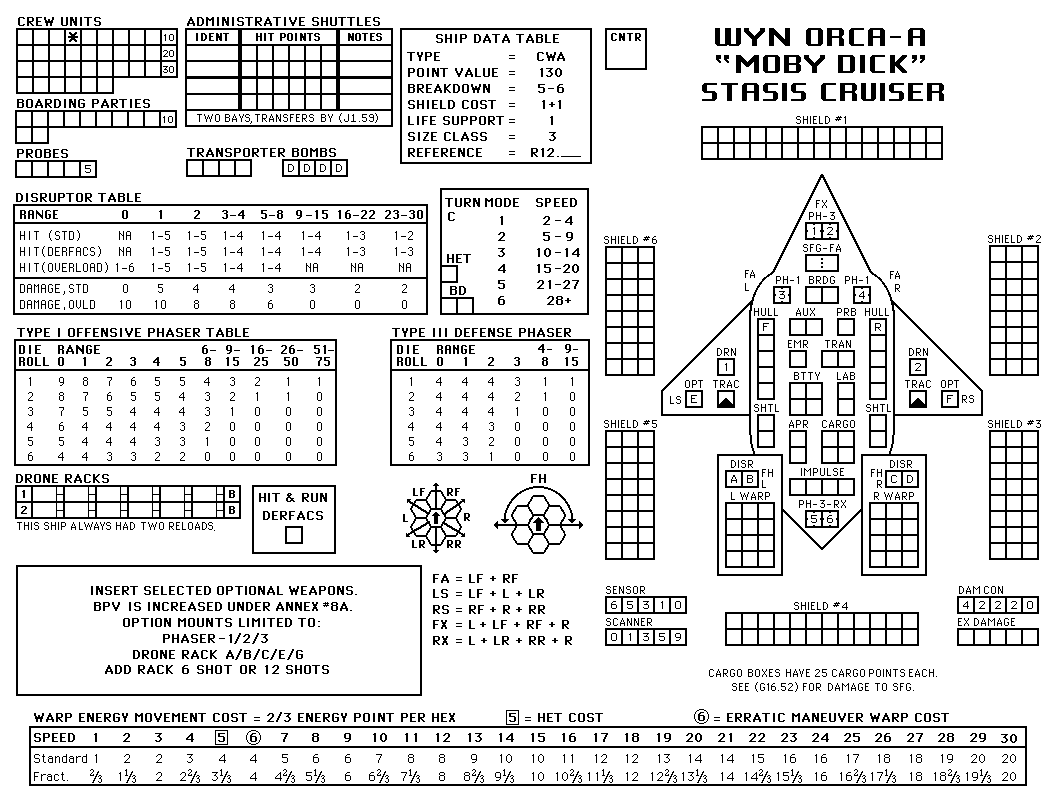
It is unknown if a SFG ever fell
into WYN hands, but the Orca was the most likely ship to mount it (The larger
CA was too rare to risk on dangerous stasis missions and the CW had enough
speed to effectively employ the device). The GIA obtained Klingon files on this
ship and codenamed it "Moby Dick". Had such a ship been built, it
might have made any attempt to penetrate the WYN Radiation Zone virtual
suicide.
Pilot
Light Tactical Transport (LTT):

Pilot-B
Light Battle Transport (LBT):

Pilot-R
Light Repair Transport (LRT):
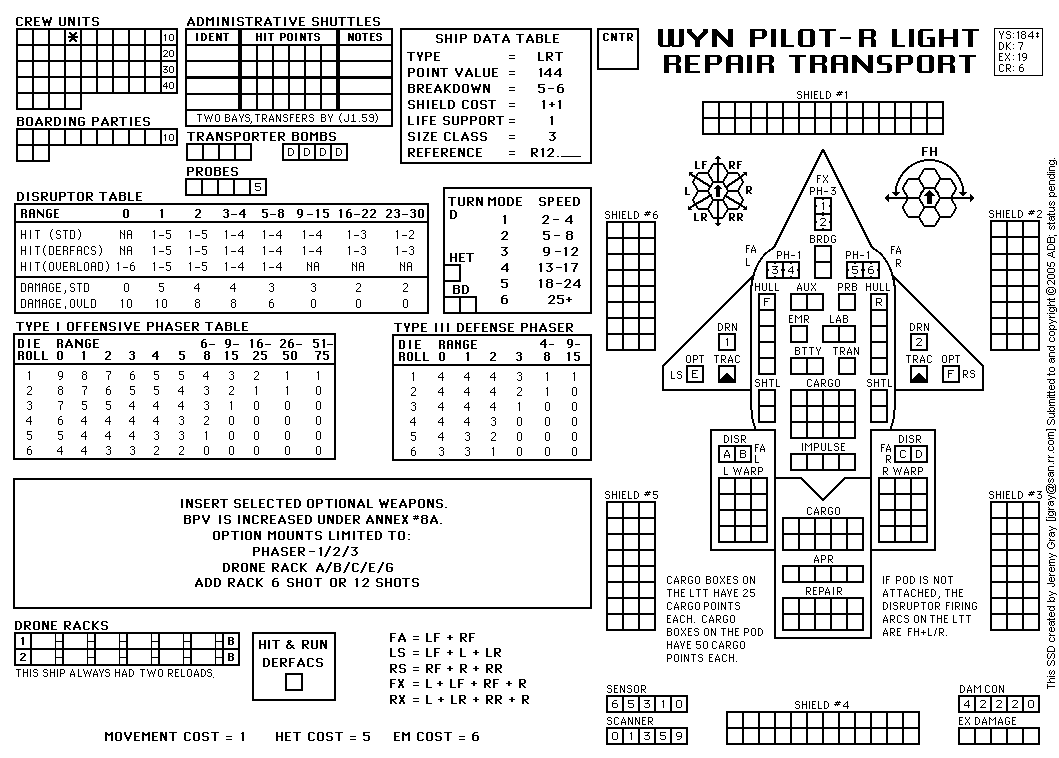


Hemi-Cuda
Heavy Frigate (FFH):

Barracuda-M
Light Minesweeper (FFM):

ISC SHIPS
Super-Heavy
Star Cruiser (SCA):

EARLY HEAVY CRUISER (CAE): The SSD shows the original ISC heavy cruiser prior to the
introduction of the many weapons of the more recognizable Star Cruiser. This ship follows the guidelines on
(R13.R1)-(R13.R3), with one exception: cargo boxes are provided to support long
range missions, similar to the DNE and CPF.
It is unclear if the first ISC heavy cruisers actually had these. If following (R13.R1)-(R13.R3) strictly, delete all cargo boxes and reduce the BPV to 147.
The phaser refit shown on the SSD first became available in
Y165. Beginning in Y168, the ISC began
conversion of these ships to the Interim Heavy Cruisers (see below). After a series of refits, these were later
refitted to true Star Cruisers (shown on the well-known CA SSD) in Y179-181.
INTERIM HEAVY CRUISER (CAI): The SSD shows the ISC Heavy Cruiser as it appeared beginning in
Y168. It shows the progressive refits described in (R13.R2) and (R13.R3). This ship’s most significant initial
improvement over the CAE is the addition of a PPD replacing the centerline Plasma-G
in Y168.
In
Y170, all ISC Heavy Cruisers were refitted, replacing the remaining Plasma-G
torpedoes with the improved Plasma-S (R13.R3).
Then, beginning in Y171, some of these ships began receiving a pair of
rear-firing Plasma-Fs, the first deployment of these
weapons in the defensive role that would later become prevalent in the ISC
fleet. According to (R13.R2), this refit
was relatively rare, and it is possible that not all ISC Heavy Cruisers
received it. By Y179-181, these ships
were again refitted, appearing as true Star Cruisers (R13.6) with their full compliment of rear-firing torpedoes. The bulk of the ships received this final
upgrade during this period, but as (R13.R2) indicates, it is possible that a
few ships appeared in this configuration earlier.
HEAVY STRIKE CRUISER (CAS): An often-requested variant, the CAS replaces the center PPD with
a Plasma-S and the outside Plasma-S tubes with PPDs. This reversed armament would make the ship a
better echelon ship, but would push the limits of the ship’s design. A three PPD version would be subject to
shock.
SELTORIAN SHIPS

JINDARIAN SHIPS


VUDAR SHIPS


FRAX
SHIPS
STRATEGIC
WEAPONS SUB (SDNL): The SDNL
is based on the Ballistic Missile Submarines of 20th Century
Earth. The Klingons apparently gained
some limited information on these vessels through a clandestine download of
some Federation memory core (most likely from a captured ship). The resulting simulator design incorporated
unique weapon launching systems called Missile
Silos (click on hyperlink for rules). The SDNL also features all the special capabilities
of other Frax subs (R51.N1) and afforded command
grade officers a particular challenge in periodic war games held by the
DSF. Depending
the loadout out of the silos, the SDNL could threaten
a well-defended base or a large squadron of ships. If operating with 3-4 “conventional” Frax subs, it provided a difficult opponent for even the
most seasoned Klingon Admirals.


